Why CISOs, CTOs, CEOs, and CFOs need to evaluate security in terms of financial exposure, not just controls.
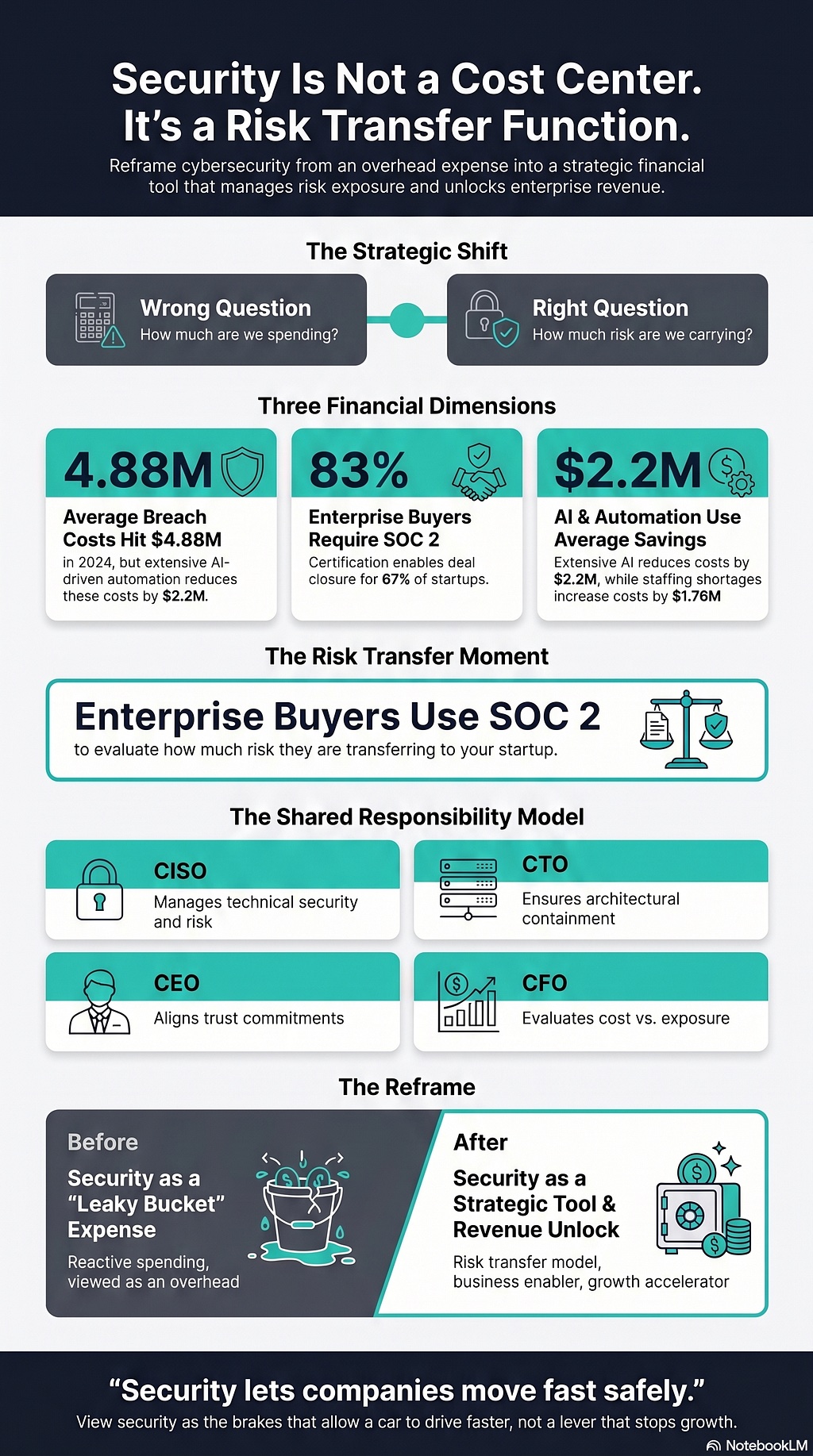
The conversation about security budgets in most organizations starts in the wrong place.
How much are we spending? Is this tool worth renewing? Can we defer this until next quarter?
These are cost questions. And cost questions produce cost answers: cut where you can, spend where you must, justify everything in terms of headcount and tooling.
The problem is that security isn’t primarily a cost function. It’s a risk transfer function. And when organizations treat it as the former, they end up making decisions that look financially sound and are operationally dangerous.
What risk transfer actually means in practice
When a company sells to an enterprise customer, something happens that rarely gets named explicitly. Risk moves.
The enterprise customer is no longer solely responsible for the data protection, system availability, access control, and incident response that your product touches. They are relying on you. When they sign your contract, they are accepting a portion of their operational, regulatory, and reputational risk exposure and transferring it to your organization.
This is why enterprise security reviews exist. They are not evaluating technical elegance. They are not checking compliance boxes. They are answering one question: can this vendor absorb and manage the risk we are about to transfer to them?
If the answer is unclear, the deal slows. If the answer is no, the deal stops.
83% of enterprise buyers now require SOC 2 before signing contracts. That number reflects a market that has internalized risk transfer. Enterprise procurement teams aren’t asking for SOC 2 because they care about the AICPA framework. They’re asking because they need evidence that their vendor can manage the risk they’re handing over.
The financial lens most leadership teams are missing
From a CFO perspective, security can be understood through three dimensions that map directly to financial exposure.
The first is exposure: what is the potential impact of a security failure? This includes direct financial loss, regulatory penalties, customer churn, and contractual liability. The global average cost of a data breach reached $4.88 million in 2024, a 10% increase from the year before. For companies in financial services, technology, and healthcare, the figure is significantly higher. These are not abstract numbers. They are the financial consequence of unmanaged exposure.
The second dimension is likelihood: how probable is a security failure given the current environment? This is influenced by attack surface, access controls, detection capability, and system complexity. Organizations with strong IAM design, centralized logging, and hardened CI/CD pipelines have meaningfully lower likelihood than those without, regardless of whether they have a compliance certification.
The third is containment: if an incident occurs, how far can it spread and how quickly can it be stopped? This is determined by IAM design, network segmentation, monitoring capability, and operational discipline. IBM’s research shows that organizations using AI and automation extensively in security operations save an average of $2.22 million per breach compared to those that don’t. The difference is containment speed, not prevention.
Security investments should reduce one or more of these three dimensions. If a proposed investment can’t be connected to exposure, likelihood, or containment, it’s worth asking why it’s being made.
Why the cost center framing fails startups specifically
In startup environments, security investment tends to be reactive. It gets triggered by a compliance requirement, an enterprise deal that stalls, or customer pressure. This leads to tool-driven decisions, inconsistent control implementation, and gaps in critical areas like identity and detection.
From a financial standpoint this creates uneven risk coverage. Some areas are over-protected because a specific tool was purchased. Others are exposed because no one has gotten around to them. The overall risk posture is not coherent. It’s a collection of point solutions assembled under pressure.
Nearly 42% of CISOs reported budget increases for 2024, reflecting growing recognition that security is a business enabler. But budget alone doesn’t solve the framing problem. A CISO who secures more budget to buy more tools while leadership still thinks of security as overhead hasn’t changed the underlying dynamic.
The shift that matters is not from smaller budget to larger budget. It’s from cost framing to risk framing.
What the conversation looks like when it’s working
Organizations that get this right think about security investments the way they think about insurance and infrastructure: not as overhead, but as the mechanism that makes other things possible.
CFOs are increasingly steering security strategy by tying security outcomes to financial metrics rather than technical capabilities. That shift changes the conversation from “how much does this tool cost” to “what risk does this investment reduce and by how much?”
In practice this means leadership teams that can answer questions like: what is our blast radius if a production credential is compromised tonight? How quickly could we detect and contain a ransomware event? What is our contractual exposure if a customer’s data is involved in an incident? What regulatory penalties are we carrying based on our current logging and access control posture?
These are not CISO questions. They are CFO and CEO questions. And organizations where leadership can answer them tend to make security investments that are coherent, proportionate, and connected to actual risk reduction.
The shared responsibility that most companies avoid
Security maturity is not owned by one role. This is worth being direct about because the diffusion of responsibility is one of the main reasons security stays in the cost center framing.
The CISO defines risk posture and control strategy. The CTO ensures the architecture supports containment and visibility. The CEO aligns security with business priorities and trust commitments to customers and partners. The CFO evaluates trade-offs between cost and risk exposure and holds the organization accountable to a coherent risk posture.
When these perspectives align, security becomes a business function. When they don’t, security becomes the CISO’s problem, underfunded and undervalued, until an incident makes it everyone’s problem.
Leading CISOs who have broken free from the cost center framing share a common approach: they demonstrate security’s value through business outcomes, not technical metrics. Not “we blocked 10,000 threats last month” but “our IAM posture reduced our breach liability exposure by X and shortened our last enterprise sales cycle by Y weeks.”
That’s the conversation that changes how security gets funded.
Final thought
Security is not about eliminating risk. That’s not possible in any system that operates at scale and handles real customer data.
It’s about understanding what risk exists, reducing unnecessary exposure, containing impact when incidents occur, and maintaining the trust that enterprise relationships depend on.
When viewed through that lens, the question isn’t how much security costs. The question is how much risk the organization is carrying, how that risk is being managed, and whether the current investment is proportionate to the exposure.
That reframe doesn’t require a new tool or a larger budget. It requires a different question at the start of the conversation.
If you’re working on building a security program that can speak to these outcomes, or preparing for enterprise due diligence and SOC 2 readiness, I work with Series A and B SaaS startups on exactly this. Feel free to DM me or reach out directly.
References