Why detection and response maturity define enterprise readiness more than any compliance framework.
I’ve had versions of the same conversation many times. A founder or CTO walks me through their security posture. MFA is enabled. Access is restricted. A compliance program is in progress or already complete. The controls are real. The intent is genuine.
Then I ask one question: what happens when something goes wrong?
Not a catastrophic breach. Just an incident. An anomalous login. A credential that may have been exposed. An unexpected API call in a production system. Something that requires detection, investigation, and a coherent response.
The answer, more often than not, is silence. Or a slow pivot to “we’d figure it out.”
That gap between having controls and being able to respond is where most startups are more exposed than they realize.
Prevention is not the same as resilience
Most early-stage security programs are built around prevention. Reduce exposure, limit access, implement best practices. This is necessary work. But it does not answer the question enterprise buyers are actually asking.
Enterprise security teams are not only evaluating whether a vendor can prevent incidents. They’re evaluating whether a vendor can manage them responsibly when they occur. Because in any modern system that handles real customer data at scale, something eventually will go wrong. Not necessarily a breach, but an incident that requires a competent response.
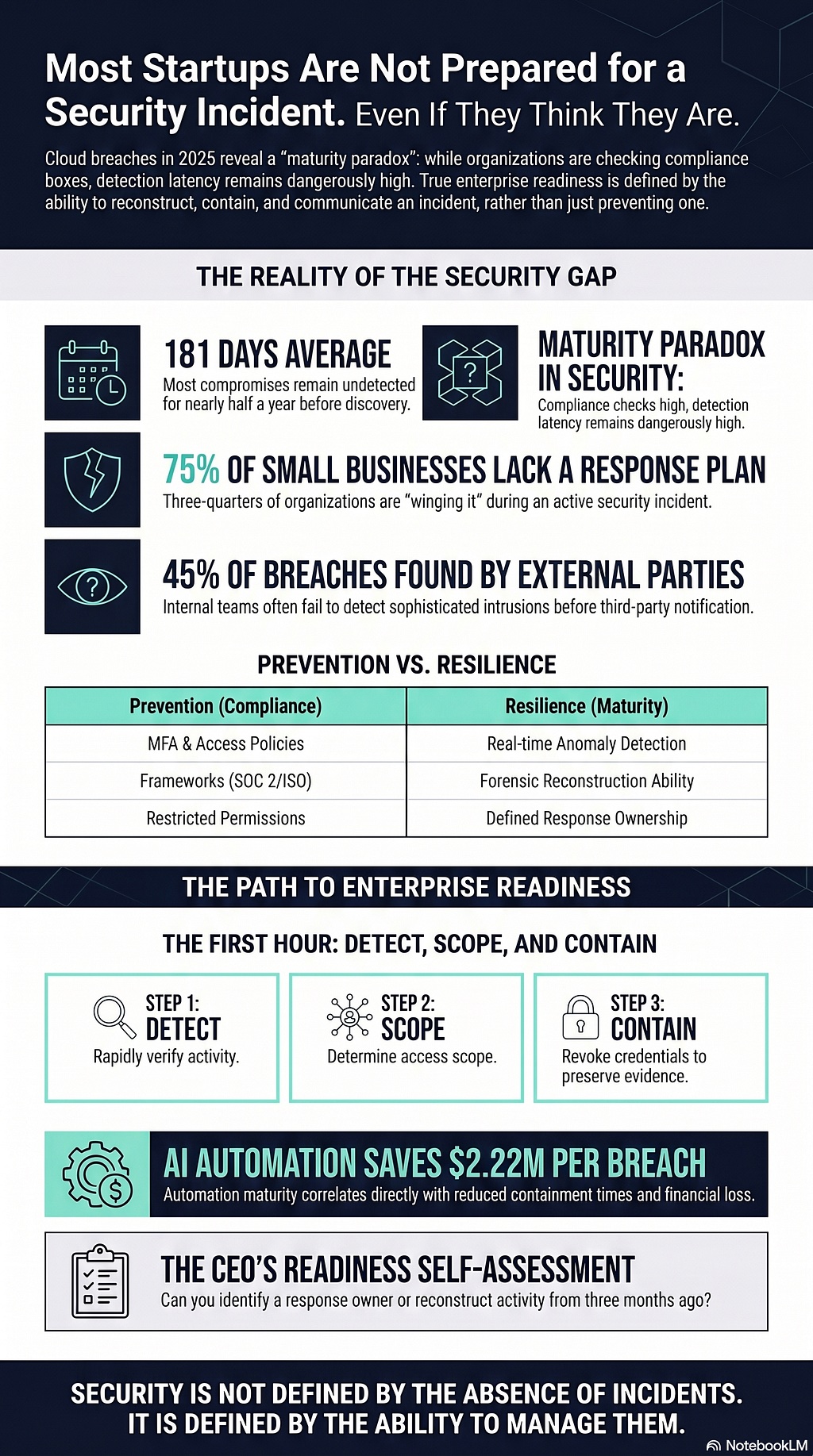
The data on this is sobering. According to IBM’s 2025 Cost of a Data Breach Report, organizations take an average of 181 days to identify a breach and another 60 days to contain it. That’s nearly eight months of exposure before the issue is fully under control. And only 30% of organizations regularly test their incident response plans, meaning most companies have no real idea whether their response process works until they need it.
For startups specifically, the numbers are worse. 75% of small businesses lack a cybersecurity incident response plan entirely. Not a weak plan. No plan.
What unprepared looks like when it actually happens
The difference between prepared and unprepared organizations becomes visible within the first hour of an incident. Not the first day. The first hour.
Unprepared environments struggle to answer questions that should be immediate: who accessed a sensitive system last Tuesday, what changed in production overnight, when did the suspicious activity begin, and what is the actual scope of impact. In practice this means logs that are incomplete or fragmented across multiple systems with no correlation capability, no clear owner for the response, and timelines reconstructed manually under pressure while something is actively wrong.
At that point the problem stops being purely technical. It becomes operational, reputational, and in enterprise contexts, contractual.
45% of breaches are still discovered by external parties rather than internal teams, meaning nearly half the time, someone else finds out before you do. That’s not a detection capability. That’s luck.
Why logging alone doesn’t solve this
The most common misconception I encounter is that having logs equals having visibility. It doesn’t.
Raw logs sitting in CloudWatch, scattered across five services, with a seven-day rotation window are not a forensic capability. They’re a passive record that may or may not contain what you need, in a form that may or may not be queryable under time pressure, retained for a period that may or may not cover the relevant window.
For logs to support real incident response they need to be centralized into a single destination, retained for meaningful timeframes beyond short debugging windows, protected from tampering by storing them separately from the systems they monitor, and structured to answer business-relevant questions quickly. Google Cloud’s audit log best practices and AWS CloudTrail guidance both make this point explicitly.
The question isn’t whether you have logs. It’s whether your logs can answer a forensic question within an hour under pressure. Those are different questions.
The first hour determines the trajectory
In most incidents, the initial phase sets everything else. Can the team confirm quickly whether activity is legitimate or anomalous? Can the scope be defined without spending three hours correlating logs across systems? Can access be restricted or revoked immediately if needed? Is there a clear response owner who knows what to do without convening a meeting to figure it out?
Organizations with defined detection and response capabilities reduce uncertainty rapidly in that first hour. They move from detection to understanding to containment with speed and clarity. Those without them experience escalation, confusion, and delay while the scope of the problem grows.
AI-driven security automation saves companies an average of $2.22 million per breach by cutting response times and improving containment. The gap between organizations that can respond quickly and those that can’t is measured in millions of dollars and months of exposure.
How this shows up in enterprise sales
Enterprise buyers ask incident response questions that look like compliance questions but aren’t. How is suspicious activity detected? What is the response timeline? Is there a documented incident response process? Can activity be reconstructed if needed?
These are trust and risk transfer questions. When an enterprise customer signs your contract, they’re accepting some fraction of your operational risk into their environment. They want to know what happens to their data if something goes wrong on your side, not just whether your controls look good on paper.
From a CRO perspective this affects deal velocity. From a CEO perspective it affects brand trust. From a CISO perspective it defines whether you’re a vendor they can defend to their board if something goes wrong.
83% of enterprise buyers now require SOC 2 before signing contracts. But SOC 2 doesn’t require you to demonstrate incident response capability in any meaningful operational sense. It requires documentation. The buyers who go beyond the questionnaire, and experienced security teams always do, are looking for evidence that you can actually manage an incident, not just describe the process.
A practical self-assessment
Four questions worth answering honestly before your next enterprise review:
How would you detect unauthorized access to a production system today? Not in theory. What tool would alert you, how quickly, and who would receive the alert?
If a developer credential was compromised right now, how long would it take to confirm the scope of what was accessed? Hours or days?
Who owns incident response in your organization? If the answer requires a meeting to determine, that’s the answer.
Can you produce a reconstructed timeline of activity in a specific system for a specific two-week window from three months ago? This is a question auditors ask. If you can’t answer it, you can’t satisfy a serious security review.
If any of these are unclear, the gap isn’t technical. It’s operational. And it’s the kind of gap that shows up immediately in enterprise evaluations.
Final thought
Security is not defined by the absence of incidents. It’s defined by the ability to manage them when they occur. The most important metric isn’t whether something goes wrong. It’s how quickly the organization can move from detection to understanding to containment.
That’s what enterprise buyers are actually evaluating. And it’s what separates vendors that close enterprise deals from vendors that stall in security reviews.
If you’re working on SOC 2 readiness, cloud security architecture, or incident response planning and want a second set of eyes, I work with Series A and B SaaS startups on exactly these problems. Feel free to DM me or drop a comment below.
References