Why activity-driven security programs produce effort without meaningful risk reduction.
Walk into most startup security reviews and you find the same thing: a roadmap that looks comprehensive on paper and leaves critical gaps in practice.
Compliance requirements. Tool implementations. Framework alignment. Best practice checklists. Everything accounted for, everything assigned equal weight. And somewhere in that list, buried under a dozen lower-stakes items, are the three or four things that actually determine blast radius when something goes wrong.
I’ve seen this pattern more times than I’d like. Teams working hard, shipping security improvements, ticking boxes, and still walking into an enterprise review unprepared for the questions that actually matter. The problem is not effort. The problem is that effort and risk reduction are not the same thing, and most roadmaps are not built to tell them apart.
The failure mode frameworks create
Security frameworks are genuinely useful. NIST CSF, CIS Controls, ISO 27001, SOC 2 — they provide structure, coverage, and a shared language for conversations with auditors and enterprise buyers. That value is real.
But they create a specific trap when applied without prioritization. Teams try to implement everything at once. Effort gets spread thin. Critical gaps stay open while peripheral controls get attention. Progress looks good on a spreadsheet and feels slow everywhere else.
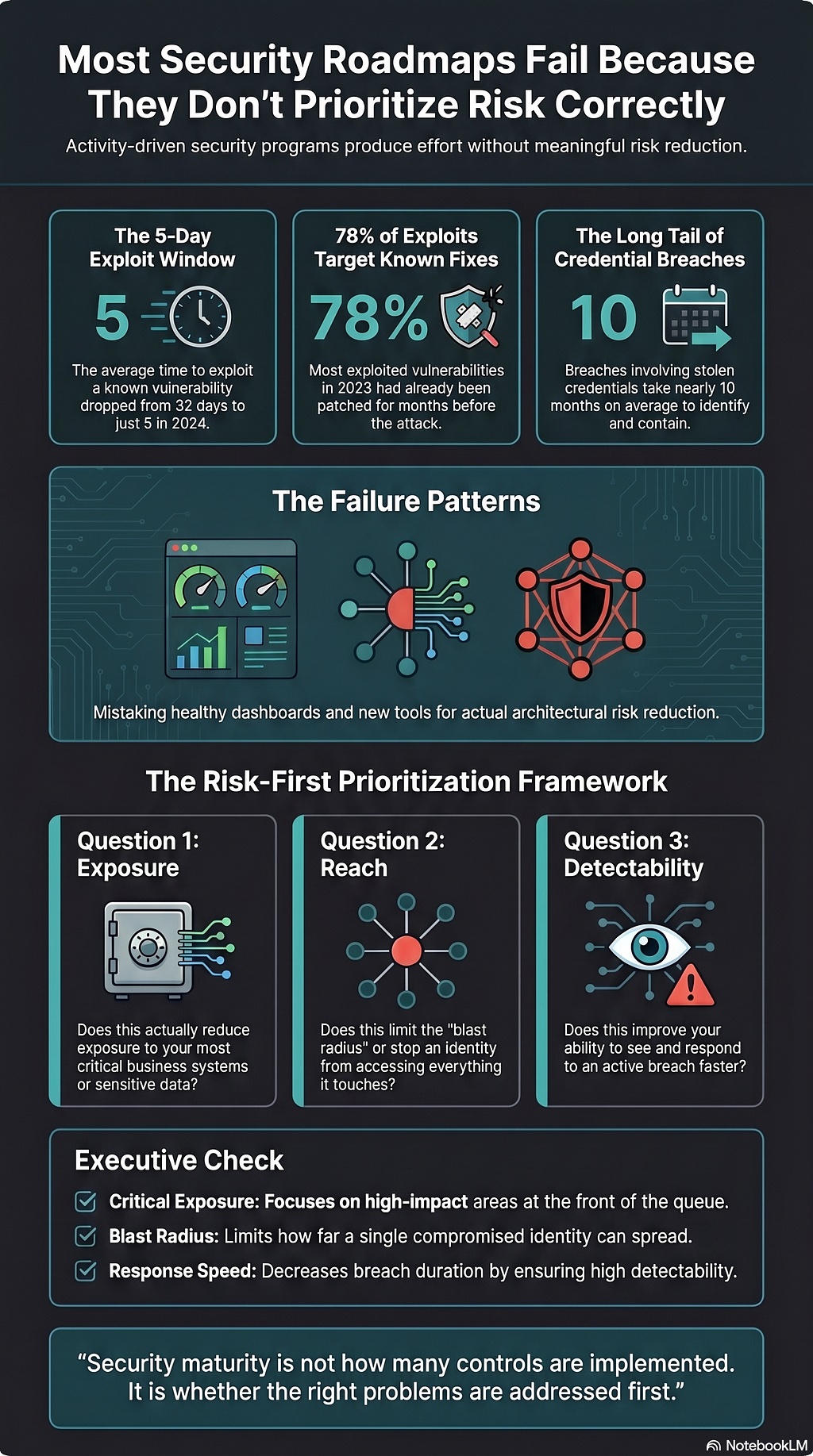
The data behind this is uncomfortable. According to IBM X-Force research, roughly 78% of vulnerabilities exploited in 2023 had already been disclosed and patched, some for months or years before the attack. Organizations were busy patching low-risk findings while known, exploitable gaps sat unaddressed. That is not a resource problem. That is a prioritization problem.
The window is also getting shorter. The average time to exploit a known vulnerability dropped to five days in 2024, down from 32 days the year before. Teams that treat all findings as equally urgent are falling further behind, not because they are slow, but because they are working on the wrong things.
What actually drives risk in most environments
In most startup environments, a small number of issues account for the majority of real exposure. Over-permissioned identities. Lack of visibility into system activity. Uncontrolled production changes. Long-lived credentials with no rotation.
These are not exotic problems. They show up everywhere, and they create disproportionate impact when exploited because they affect reach and detectability, not just a single system. One over-permissioned identity is not one problem. It is a potential path to everything that identity can touch.
At the same time, organizations often invest significant effort in things that look like security work but do not meaningfully reduce exposure: low-impact configuration changes, tool optimization, peripheral controls that address theoretical risks rather than real ones. The effort is real. The risk reduction is marginal.
The result is a security program where effort does not track with risk, and nobody at the leadership level has a clear way to see the difference.
A more useful way to think about prioritization
Security decisions become much clearer when evaluated through three questions rather than a framework checklist.
The first is exposure. If this control fails or this gap gets exploited, what is the actual impact? Does it affect sensitive data, production systems, or multiple customers? High-exposure areas should move to the front of the queue, not because they are interesting to work on but because the cost of leaving them unaddressed is concrete and measurable.
The second is reach. How much of the environment can this issue affect? Is access scoped or broad? Can it move laterally? Does it affect critical infrastructure or a single non-production service? Issues with wide reach increase blast radius in ways that a single vulnerability with no lateral movement potential simply does not.
The third is detectability. If this issue gets exploited tonight, how quickly will anyone know? Is the activity logged, monitored, and correlated? Are alerts defined and tested? Low detectability does not increase the probability of an incident, but it dramatically increases duration and therefore cost. IBM’s research shows that breaches involving compromised credentials take an average of 292 days to detect and contain. Most of that time is not the attacker being clever. It is the defender having no visibility.
These three questions do not replace frameworks. They layer on top of them to answer the question frameworks cannot: given limited time and attention, where should we focus first?
Where organizations actually get stuck
A few patterns show up consistently in environments that struggle with prioritization.
The first is prioritizing visibility metrics over impact. Security dashboards look healthy. Coverage scores are high. But the underlying architecture was never designed for containment, and nobody has tested whether the logging actually supports incident investigation. The numbers feel like progress. The risk has not changed.
The second is over-investing in tooling before fixing architecture. A new SIEM, a vulnerability scanner, an endpoint detection platform. These are real investments with real value. But tools sit on top of architecture. If the IAM design means one compromised account can reach everything, adding a tool to monitor that access does not reduce blast radius. It just generates more alerts about a structural problem that was not addressed.
The third is treating all findings equally. A critical vulnerability in a non-production system with no customer data is not the same as a moderate finding in the system that handles payment processing. CVSS scores and compliance checklists treat them the same way. Risk-based prioritization does not.
What leadership alignment actually changes
Prioritization cannot live entirely in the security team. The decisions that matter most, where to focus, what to defer, what architectural changes to make, require input from people who understand both the risk posture and the business context.
The CISO has the clearest view of risk posture and control strategy. The CTO understands which architectural changes are feasible and which would require rewriting systems that are actively in use. The CEO knows which enterprise relationships are at stake and what the business can absorb. The CFO can evaluate the financial trade-off between investing now versus absorbing breach costs later.
When these perspectives are aligned, security roadmaps start reflecting actual business priorities rather than framework coverage targets. When they are not, roadmaps drift toward whatever the security team can justify independently, which is rarely the highest-impact work.
A simple executive check
Before committing to any security initiative, three questions are worth asking out loud in a room where the CISO, CTO, and at least one business leader are present.
Does this reduce exposure to critical systems or data? Does this limit how far an issue can spread? Does this improve the ability to detect and respond?
If the answer to all three is unclear, the priority should be reconsidered. Not because the work is unimportant, but because there is almost certainly something else on the list that scores higher on all three dimensions and is sitting further down the queue.
Final thought
Security maturity is not a function of how many controls are implemented. It is a function of whether the right problems are addressed first.
Organizations that get prioritization right tend to move through enterprise security reviews faster, reduce breach costs when incidents occur, and build the kind of trust with customers that does not require a compliance report to demonstrate. Not because they do more. Because they focus on what actually reduces risk.
The difference between a security program that works and one that just looks like it works is usually not the tools, the frameworks, or the budget. It is whether the people making decisions understand which problems matter most and act on that understanding before a forcing function demands it.
If you are building a security program and want help thinking through risk-based prioritization for your environment, feel free to DM me. I work with Series A and B SaaS startups on SOC 2 readiness, cloud security architecture, and IAM design.
References