A simple framework to assess whether your security posture will pass real-world scrutiny.
Enterprise security reviews feel complicated from the outside. Hundreds of questionnaire items. Framework references. Evidence requests. Audit timelines.
But after reviewing a lot of startup environments, I’ve noticed that the actual determination, ready or not ready, usually comes down to four things. Not dozens. Four signals that tell an experienced reviewer whether a startup has meaningful control over its environment or whether risk is essentially unmanaged.
None of them require a large security team. None of them require expensive tooling. They do require intentional decisions that most startups keep deferring.
Here’s what those signals look like in practice.
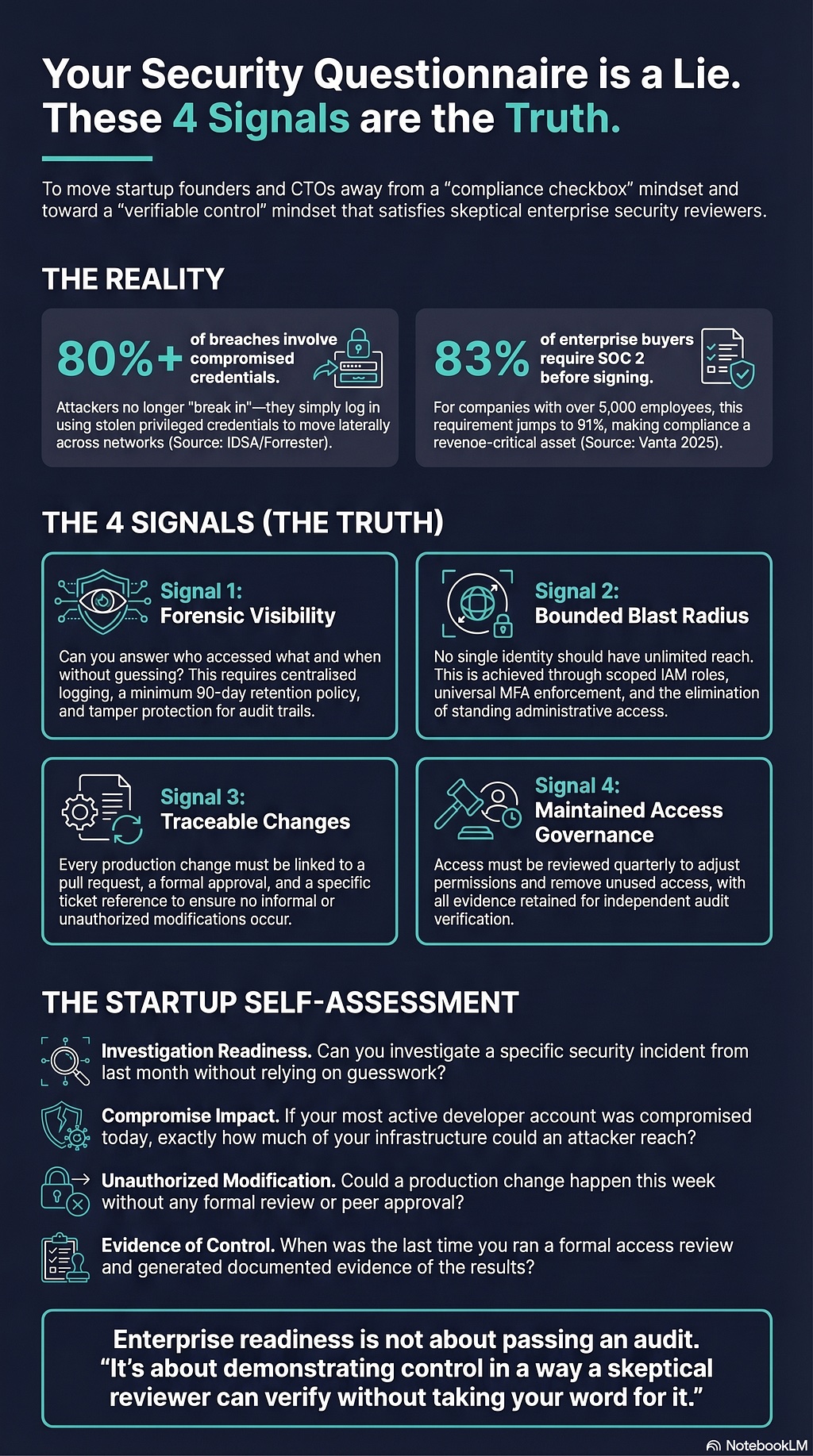
Signal 1: You can answer “who did what” without guessing
This is the one I check first, and it’s the one that trips up the most environments.
The question is simple: if something happened in your system last Tuesday, can you reconstruct it? Who accessed what, when, from where, and what actions were taken? Can you answer that within an hour, or does it require piecing together logs from five different services, some of which have already rolled off?
According to IBM’s 2024 Cost of a Data Breach Report, credential-based breaches take an average of 292 days to identify and contain. Part of what makes them so hard to detect is exactly this: fragmented, insufficient logging that makes it impossible to reconstruct a timeline until long after the damage is done.
Enterprise reviewers know this. When they ask about logging, they’re not checking a box. They’re assessing your forensic capability. Can you prove what happened, or can you only guess?
What good looks like: logs are centralized into a single destination, retained for at least 90 days with longer cold storage, protected from tampering, and queryable by resource, user, and time range. Google Cloud’s audit log best practices and AWS CloudTrail guidance both emphasize centralization and protection as non-negotiable starting points.
If you can’t answer “who accessed this S3 bucket on a specific date” within an hour, this signal is missing.
Signal 2: No single identity has unlimited reach
The second thing I look for is blast radius. Specifically: if one account is compromised tonight, how far can an attacker go?
In early-stage environments, the answer is often “everywhere.” A developer account with AdministratorAccess that was set up during initial infrastructure work and never scoped down. A service account with wildcard permissions because it was faster. A CI/CD pipeline role that can modify any resource in the account.
This isn’t a hypothetical concern. The Identity Defined Security Alliance’s research consistently shows that over 80% of breaches involve compromised credentials. The size of the incident is directly determined by how much the compromised identity can reach.
Enterprise reviewers aren’t looking for perfect IAM. They’re looking for evidence that blast radius has been intentionally limited. Scoped roles. Separation between development and production environments. No long-lived administrative credentials. MFA enforced universally, not selectively.
Microsoft’s identity security best practices frame identity as the primary security perimeter, which is the right framing. If one account can do everything, risk is effectively unbounded. That’s what a reviewer sees when they look at your IAM configuration.
Signal 3: Changes to production are predictable and traceable
Enterprise buyers care less about how fast you move and more about how predictably you operate. Speed is expected. Predictability is what builds trust.
The question here is: if a change was made to production last week, can you show who approved it, when it was deployed, and what ticket or pull request it corresponds to? Or could someone have pushed a change directly to main at 2am without any review or trace?
SOC 2 CC8 and ISO 27001 A.12.1.2 both require that production changes be authorized, tested, and traceable. This isn’t bureaucracy for its own sake. It’s the mechanism that prevents a single actor from unilaterally modifying production, whether accidentally or intentionally.
In practice this means protected main branches with required pull request reviews, CI/CD enforced deployments rather than manual pushes, and a clear mapping between tickets and deployments. Every production change should have a paper trail that an auditor can follow without asking you to explain it.
The absence of this signal is one of the fastest ways to lose confidence in a security review. Informal production changes suggest that the environment can be modified without oversight, which is exactly the condition attackers exploit.
Signal 4: Access is reviewed and adjusted over time
The fourth signal is about maintenance, not just design. It’s one thing to implement least privilege on day one. It’s another to keep it in place as the company grows, roles evolve, and people move between teams.
This is the privilege creep problem. An engineer joins as a backend developer and gets appropriate access. Six months later they move to a different team, pick up additional access for a project, and the original permissions are never removed. A contractor finishes their engagement but their account stays active for another three months. A staging environment gets production-level access “temporarily” and the temporary access becomes permanent.
Under SOC 2 CC6 and ISO 27001 A.9.2.5, access must be reviewed periodically. The standard expectation is quarterly. What auditors look for is a documented cadence, manager attestation, evidence of permissions actually being changed or revoked, and records retained for review.
The practical test is simple: when did you last run an access review? Do you have documentation showing what was reviewed, what changed, and who approved it? If the answer is “we remove access when people leave,” that’s not an access review process. It’s offboarding. Enterprise reviewers know the difference.
Why these four signals and not dozens of others
These four map directly to what enterprise security teams are actually evaluating, regardless of which framework or questionnaire they’re using.
Visibility: can you detect and investigate incidents? Signal 1 answers this. Containment: if something goes wrong, how bad does it get? Signal 2 answers this. Predictability: can production be modified without oversight? Signal 3 answers this. Governance: do controls hold over time or just on day one? Signal 4 answers this.
A 2025 Vanta survey found that 83% of enterprise buyers now require SOC 2 compliance before signing contracts, and 67% of startups that achieved certification closed deals they would otherwise have lost. The underlying reason is that SOC 2 forces a company to demonstrate exactly these four signals with evidence.
But you don’t need a full compliance program to get there. You need these four things operating and documentable.
A quick self-assessment
Four questions worth answering honestly:
Can you investigate an incident from last month without piecing together logs from multiple systems? If no, Signal 1 is missing.
If your most active developer account was compromised tonight, what could an attacker reach? If the answer is “most things,” Signal 2 needs work.
Could a production change happen this week without a pull request review or deployment approval? If yes, Signal 3 is missing.
When did you last run an access review with documented evidence of what changed? If you can’t answer this, Signal 4 isn’t in place.
None of these require a security team to fix. They require intentional decisions that most startups keep deferring until a forcing function arrives.
Final thoughts
Enterprise readiness is not about passing an audit. It’s about demonstrating control in a way that a skeptical external reviewer can verify without taking your word for it.
These four signals are what that looks like in practice. When they’re present, trust follows relatively quickly. When one or more are missing, friction appears immediately and the gap between current state and required maturity tends to be larger than it looks.
The good news is that none of these require months of work to establish. They require prioritization. Which, as we’ve established, is the actual problem.
References