Security doesn’t fail because teams don’t care. It fails because they’re optimizing for something else.
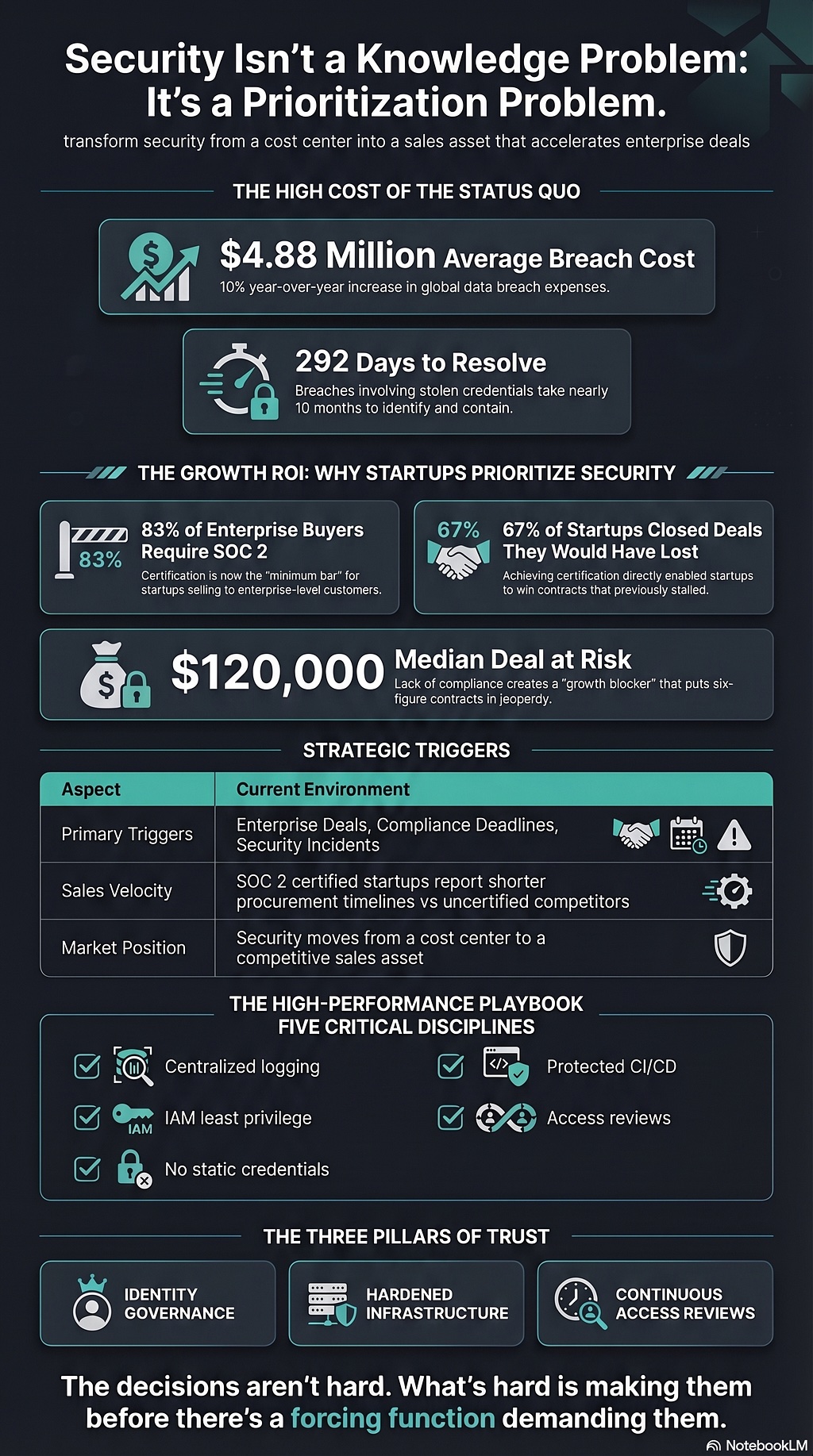
I’ve never walked into a startup environment and found a team that didn’t know what good security looked like. They knew. They could tell me exactly what needed fixing: the IAM roles that were too broad, the logging that wasn’t centralized, the credentials sitting static for two years, the CI/CD pipeline anyone on the team could modify.
They knew. They just hadn’t done it yet.
That gap, between knowing and doing, is not a knowledge problem. It’s a prioritization problem. And it’s worth being honest about why it happens, because the usual framing of “startups don’t take security seriously” misses what’s actually going on.
What startups are actually optimizing for
In the early and growth stages, the priorities are real and reasonable. Ship faster. Close the enterprise deal. Keep engineering unblocked. Reduce operational complexity. These aren’t wrong priorities. They’re survival priorities.
Security competes with all of them. And in most environments, security loses, not because it’s unimportant, but because it doesn’t feel urgent. Nothing bad has happened yet. The systems are working. The team is moving fast. The cost of not fixing the IAM roles today is invisible.
So the decision gets deferred. Reasonably. Logically. And then it gets deferred again.
This pattern is well documented. Drata’s research on SOC 2 for startups notes that security is typically treated as an afterthought when product-market fit and growth are the most pressing objectives. The irony is that this deferral often costs more than the controls themselves would have.
The problem with security debt specifically
Technical debt is annoying. It slows you down, creates friction, makes engineers grumble. But it’s visible. You feel it every time you touch the codebase.
Security debt is different. It’s invisible until it isn’t. Broad IAM roles don’t slow anything down. Minimal logging doesn’t cause errors. Long-lived credentials keep working fine. Everything looks normal right up until something goes wrong.
And when it does go wrong, the bill is significant. According to IBM’s 2024 Cost of a Data Breach Report, the global average cost of a breach hit $4.88 million in 2024, a 10% increase from the year before and the largest annual jump since the pandemic. 70% of breached organizations reported significant operational disruption. For most, recovery took more than 100 days.
That’s not a rounding error. That’s an existential event for an early-stage company.
What makes it worse: breaches involving compromised credentials, the exact failure mode that broad IAM and static secrets create, took an average of 292 days to identify and contain. Nearly ten months of exposure before anyone knew.
The three triggers that make security suddenly urgent
In practice, there are three things that convert security from “we’ll get to it” into “we need this fixed by end of week.”
The first is an enterprise deal. A Fortune 500 sends a 200-question security questionnaire, and the answers aren’t there. A 2025 Vanta survey found that 83% of enterprise buyers now require SOC 2 compliance before signing contracts. 67% of startups that obtained SOC 2 certification reported it directly enabled them to close deals they would otherwise have lost, with a median deal size of $120,000. The deal doesn’t die immediately when the questionnaire arrives, but it stalls. And a stalled deal has a way of quietly dying.
The second is a compliance requirement. SOC 2, ISO 27001, or a contractual obligation from a customer. These create hard deadlines. Suddenly the team is building a security program under audit pressure instead of building it intentionally. The timing matters more than people realize: a SOC 2 Type II report requires a 3 to 12 month observation period that cannot be shortened. Starting too late means missing the window entirely.
The third is an incident. A credential gets leaked, a bucket gets discovered publicly accessible, a customer raises a concern. Nothing focuses the mind like an actual event.
Before one of these three things happens, security is theoretical. After it happens, it’s immediate. The problem is that the gap between current state and required maturity is often much larger than it looks from the outside.
Why delaying creates more risk, not less
When security improvements get deferred long enough, they stop being improvements and start being architectural problems.
Identity gets over-permissioned because access was granted quickly and never cleaned up. Systems lack visibility because logging was never prioritized. Processes don’t exist because nobody documented the decisions that were made. The architecture was never designed with containment in mind because containment wasn’t a concern when it was built.
Fixing these things under pressure is expensive. But more importantly, fixing them during a critical moment, an active enterprise deal, a live audit, an ongoing incident, introduces its own risk. You’re changing things in production while someone is watching, or while something is actively wrong.
SSL Insights reports that by 2025, 60% of companies evaluate cybersecurity risks before closing business deals. That number will only go up. The cost of doing security right early is low. The cost of doing it right under pressure is high. That math is obvious in retrospect. It’s invisible in the moment.
What teams that get this right actually do
They don’t try to build a mature security program on day one. That’s not the point. A seed-stage company doesn’t need a full GRC platform and a dedicated security team.
What they do is treat a small set of foundational controls as non-negotiable from early on: centralized logging, IAM scoped to least privilege, no long-lived static credentials, protected CI/CD pipelines, a basic access review process. Not because of compliance. Because these are the controls that contain blast radius, enable investigation, and make everything else easier.
The difference isn’t effort. It’s timing. The same work that takes two weeks when done intentionally early can take two months when done reactively under pressure, with more risk along the way. Workstreet’s analysis of hundreds of SOC 2 implementations puts it plainly: the worst time to start thinking about security controls is when you have a large enterprise deal on the line. If you’re starting from scratch at that point, you’re already 3 to 5 months away from closing.
The reframe that actually helps
Security is usually positioned as friction. A cost center. Something that slows engineering down.
That framing is wrong, and it’s worth being direct about it. Security done well reduces friction later. Enterprise reviews move faster when controls are already in place. Audits are straightforward when evidence exists. Incidents are containable when blast radius is limited. Systems are easier to reason about when access is well-defined.
IBM’s research quantifies the other side of this: organizations that use AI and automation extensively in security prevention workflows spend $2.2 million less per breach on average than those that don’t. Organizations with strong IAM solutions save up to $223,000 annually. The cost is upfront. The benefit compounds.
That’s a good trade. And it’s worth making it explicitly rather than letting the decision get made by default through repeated deferral.
Final thoughts
Startups rarely fail security reviews because they didn’t care about security. They fail because they delayed the right decisions until the wrong moment.
The decisions themselves aren’t hard. The IAM scoping, the logging setup, the credential rotation, the pipeline controls. None of it is complicated. What’s hard is making those decisions before there’s an external forcing function demanding them.
That’s the prioritization problem. And unlike most problems in a startup, this one gets harder the longer you wait.
References